Aeronautical and aerospace technology solutions
Lighter-than-air aircraft.
Omega AeroSystems is an aeronautical engineering company that conceives and develops lighter-than-air aircraft and solutions, from robotic airships to new platforms on demand. To expand its market, it has partnered with C.A.R.T - Canadian Advanced Rescue Technologies, forming the joint venture Lighter-Than-Air AeroSystems Canada Inc – LTAAC, incorporated in Quebec, Canada, to offer solutions for both civil and military use.
Joint venture · LTAAC
A company with a track record, partner in LTAAC.
LTA AeroSystems Canada Inc. (LTAAC) is the joint venture that brings together the experience of Omega AeroSystems and C.A.R.T. - Canadian Advanced Rescue Technology Inc. Omega joins as an active company, registered in 2011, with many years of experience in the design and construction of lighter-than-air systems, including robotic airships.

Omega AeroSystems
Lighter-than-air engineering
Responsible for the following projects:
- Special Shape Manned Hot Air Balloons, winner of international awards (Albuquerque, New Mexico)
- High-Capacity Cargo Airship (Airship do Brasil): Conceptual Design and Technical and Economic Feasibility Study
- Stratospheric Airship for Telecommunications and Remote Sensing – StratoSat
- Medium-Capacity Thermal Airship for Cargo and Passengers
- Long-Range Autonomous Airship for Maritime Patrol and Port Surveillance (Harbour Hawk)
- Conception, Design, Construction and Flight Testing of the DirBot 40 DRONI “Noamay” robotic airship, which flew in 2018 using thrusters with 360° vectoring
 C.A.R.T
Autonomous rescue systems
Canadian autonomous rescue company for defence and medical use, creator of SLED, an innovative high-tech drone for casualty evacuation and in-flight first aid, for both civil and military use (MEDEVAC).
 LTAAC
Solutions for demanding missions
Joint venture created to combine the expertise of C.A.R.T and Omega AeroSystems to develop and deliver innovative lighter-than-air solutions. It is preparing to build and flight-test the second prototype, P2, developed from the version already flown in Brazil.
C.A.R.T and LTAAC information as published on the LTAAC website and the C.A.R.T website.
History
More than two decades of lighter-than-air history.
- 2003
Award-winning Special Shape balloons in Albuquerque, New Mexico, USA
Engineer Christian Lima do Amaral conceives, designs and supervises the construction and flight testing of the “Little Bees”, special shape balloons 31.4 m tall with a volume of 2,800 m³, designed and built in 100 days. They win first place in the “Best Design” category at the 2003 Albuquerque International Balloon Fiesta, among 750 balloons from 21 countries.
- 2011
Omega AeroSystems is registered
The company is registered in the state of Paraná, Brazil, with experimental research and technological development as its main activity, at the request of CENPES – Petrobras Research Center, for the analysis and initial study of long-endurance, long-range lighter-than-air solutions for the oil industry.
- 2014
Start of the DirBot 40 DRONI “Noamay” project
Coordinated by CTI Renato Archer and funded by CNPq (Brazil’s National Council for Scientific and Technological Development) from 2014 to 2017, the Robotic Airship of Innovative Design for Environmental Monitoring in the Amazon brings together universities, research institutes and Omega. “Noamay” means “Guardian” in the indigenous language.
- 2018
First flight of the DirBot 40 DRONI “Noamay” airship
On 3 March, the airship designed and built by Omega makes its first flight, remotely controlled, in Balsa Nova (Paraná, Brazil), and is featured in Pesquisa FAPESP magazine in May.
- 2020
International scientific publication
The system architecture is published in the paper “System Architecture of a Robotics Airship”, in the Proceedings of IDEAS 2019 (Springer), with Christian Amaral among the co-authors.
- Today
Partner in LTAAC
Omega brings its experience in lighter-than-air aircraft to LTA AeroSystems Canada Inc., a joint venture with C.A.R.T.
Noamay · Technology proven in flight
Four thrusters with three-dimensional vectoring.
The DirBot 40 DRONI “Noamay”, an unmanned airship designed and built by Omega, has four high-power electric motors that can be vectored through more than 180° in a coordinated way. This allows it to take off and land vertically, hover and manoeuvre at low speeds.
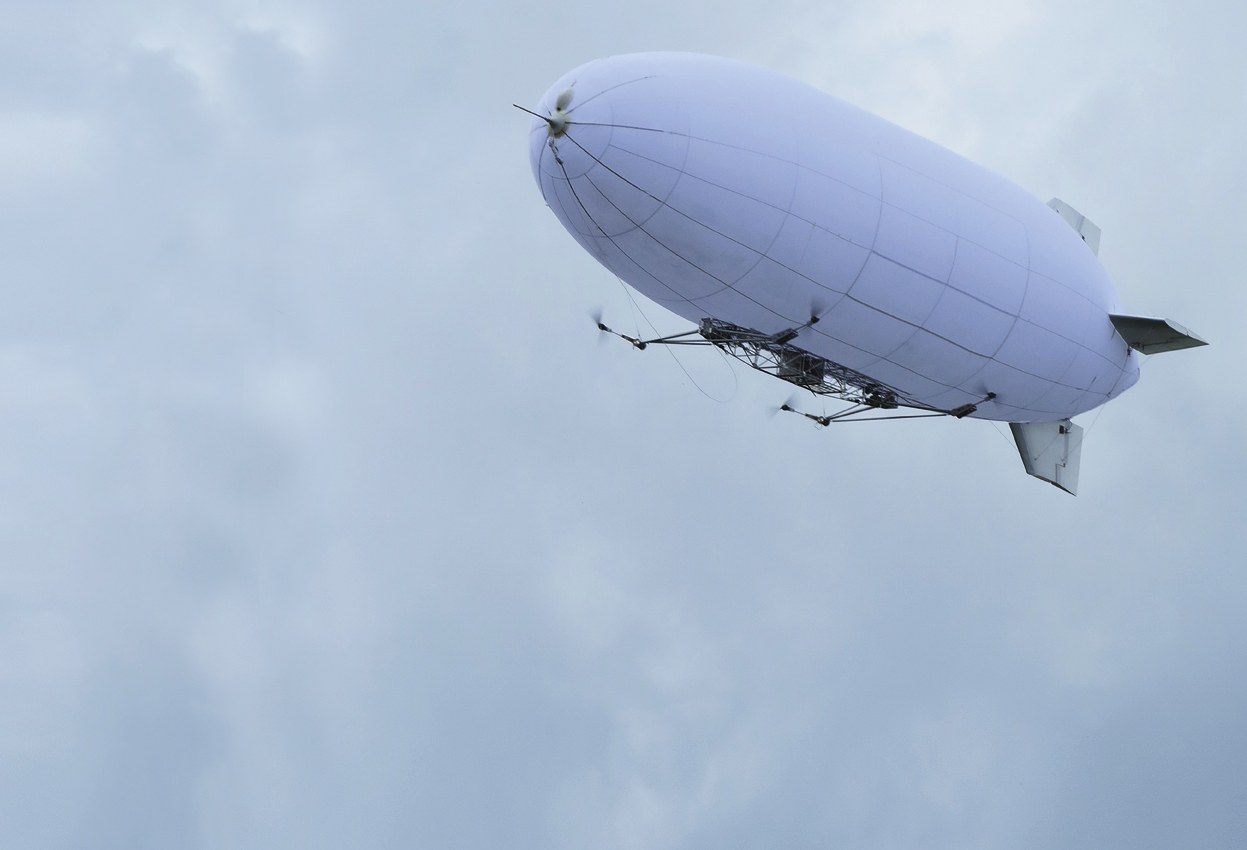
“This new system, which we call multidimensional vectoring, allows the aircraft to be controlled more precisely along its three axes, which makes hovering easier even in crosswinds.”
- Length
- 11 m
- Central diameter
- 2.5 m
- Mass without helium
- 38 kg
- Payload
- 6 kg
- Helium volume
- 40 m³
- Propulsion
- 4 electric motors with three-dimensional vectoring
- Endurance
- About 1 hhigh-capacity LiPo batteries
- Operation
- Unmannedpredefined route or remote piloting
Data published in Pesquisa FAPESP (2018) and Jornal da Unicamp (2019), both in Portuguese. When empty and folded, the envelope fits in a large suitcase.
Research ecosystem
Developed in a network with top-tier institutions.
Omega was the company that designed and built the aircraft as part of a multi-institutional project. Research with Noamay continued under the INCT (National Institute of Science and Technology) for Cooperative Autonomous Systems (InSAC).
In the press and in the literature
Institutions taking part in the project
 CTIRenato Archer Information Technology Center: coordination
 ITAAeronautics Institute of Technology
 UnicampUniversity of Campinas: automatic control and guidance
 UFAMFederal University of Amazonas
 IDSMMamirauá Institute for Sustainable Development
 ISTInstituto Superior Técnico, Lisbon, Portugal
Leadership
Christian Lima do Amaral
President · Mechanical and aeronautical engineer, University of São Paulo (USP)
Christian leads Omega AeroSystems and brings together experience in the Design and Construction of Experimental Light Aircraft, Certification of Aircraft and Aeronautical Companies, Flight Safety, Design and Construction of Lighter-Than-Air Aircraft, and the Conception and Design of Autonomous Aerial Systems, as well as experience in planning and fundraising for the development of technology projects.
He created the special shape balloons awarded in Albuquerque in 2003 (Little Bees). At Omega, he conceived, designed and led the construction of the DirBot 40 DRONI, in a network with top-tier research institutions. He co-authored an international publication on the system architecture.
Why lighter than air
In many missions, staying aloft matters more than flying fast.
Endurance, stability and payload capacity make it possible to meet a demand that small drones cannot. That is the space where Omega develops its platforms.
Longer flight time
Drone batteries last a few tens of minutes. Airships carry their own weight with lifting gases and spend energy only to move and manoeuvre.
More payload
Aerostatic lift allows much heavier loads than drones, on long-duration flights.
Stable hovering
A platform that holds steady over a fixed point, with control along all three axes.
Quiet operation
Electric propulsion keeps the airship quiet during operation.
Defence application
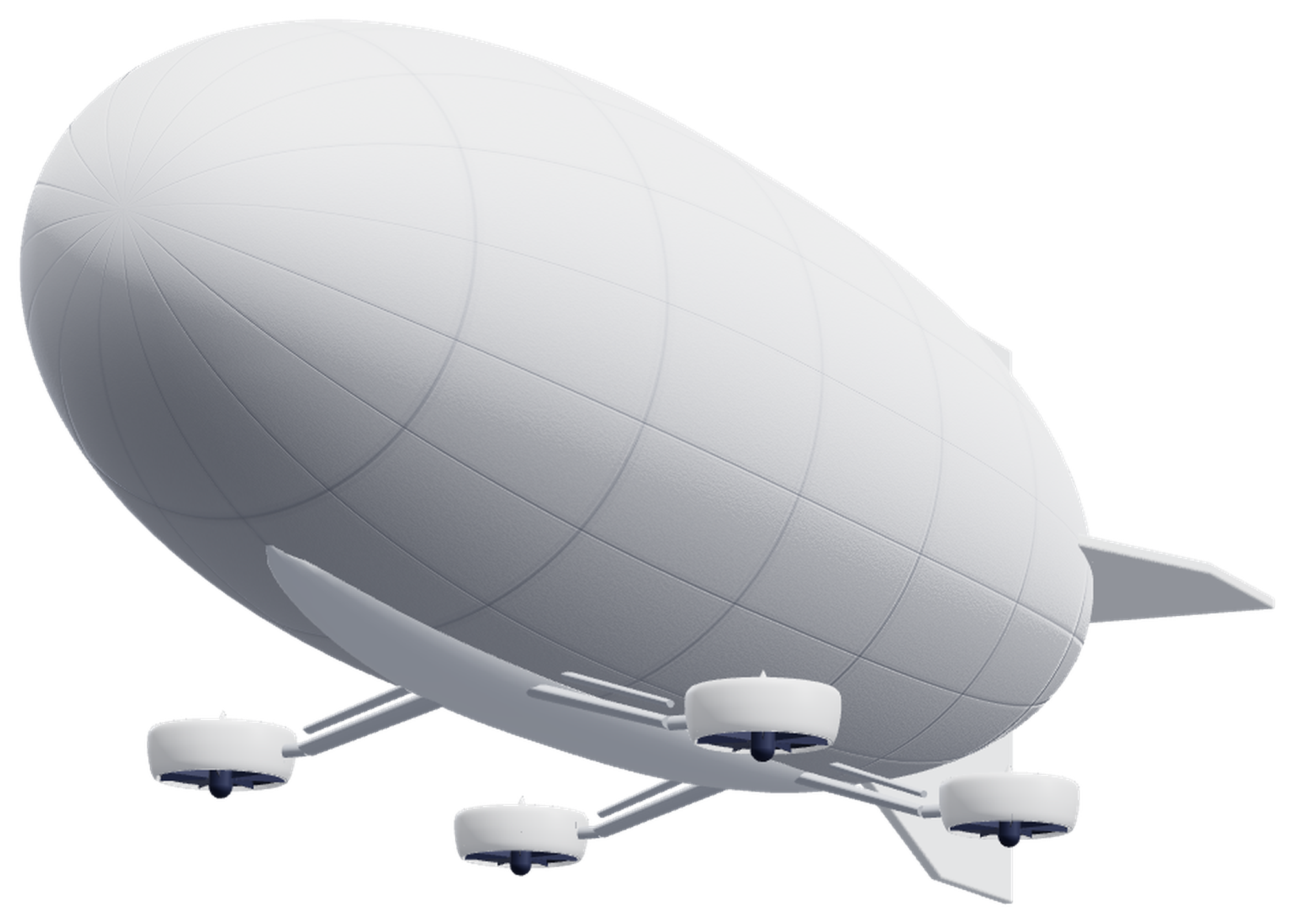
D3 – Drone Defense Dome: air cover to protect the mission.
In the C.A.R.T system, the D3 - Drone Defense Dome protects the military version of SLED, its casualty evacuation drone (MEDEVAC). The D3 airships, carrying a surveillance system and interceptor drones, remain over the area of operations, providing air cover and long-range monitoring for SLED. They can also provide SLED with precise positioning support, even without GNSS.
The project integrates, in a highly efficient way, both Omega’s long-standing expertise and the extraordinary technological and business capability of C.A.R.T.
- Platform
- D3
- Length
- 13.7 m
- Diameter
- 4.0 m
- Volume
- 120 m³
Conceptual 3D model based on the D3 drawing. System described by C.A.R.T on its website and in its Q2 2026 report.
Development areas
Future solutions derived from technology already developed.
The established base of aeronautical engineering technology enables the conception and development of innovative solutions beyond those already delivered, according to the specific demands of each operational scenario.
Defence
Lighter-than-air platforms for demanding missions, such as the D3 · Drone Defense Dome.
Mobile drone base
An airship as a mothership to recharge drones in the field, a concept studied within the project’s research network.
Telecommunications and Remote Sensing
Airships and aerostats as elevated platforms for telecommunications and remote sensing.
Small-cargo logistics
Air transport to hard-to-reach locations, a concept studied within the project’s research network.
Efficient propulsion and precise control
Multidimensional vectoring for hovering and precise manoeuvring at low speed.
Custom projects
Lighter-than-air aircraft and systems designed for each client’s mission.
Contact
Do not hesitate to get in touch:
For further information, technology partnerships or applications on demand, talk to us directly.
- Mobile and WhatsApp+55 41 99806-3015
- Emailchristian.amaral@omegaaerosystems.com.br
- LocationCuritiba-PR | Brazil